- Your cart is empty Browse Shop
Biological home wastewater treatment systems – available models. How to choose the best wastewater treatment system?
A home biological wastewater treatment system is a modern solution for those wishing to effectively treat domestic wastewater and reduce disposal costs. By utilizing natural biological processes, it is possible to treat wastewater from households, holiday homes, and other small-scale facilities.
Nolen offers solutions designed for the construction of residential wastewater treatment systems. Selecting the appropriate model should take into account factors such as the number of residents, the volume of wastewater generated, soil and groundwater conditions, and the method of managing the treated water.
In this article, we present key information about biological wastewater treatment plants, their types and applications, as well as the parameters worth checking before making a purchase.
What is a home biological wastewater treatment system?
A biological home wastewater treatment system is an installation designed to treat domestic wastewater by utilizing the activity of microorganisms. Bacteria and other organisms responsible for biological processes break down the pollutants present in the wastewater, thereby enabling the production of treated water.
Depending on the technology employed, a biological treatment plant may utilize, among other things:
- Activated sludge – microorganisms forming a suspension that participates in the biological decomposition of pollutants.
- Biological bed – a surface on which microorganisms that treat wastewater develop.
- Fluidized biological bed – special shaped elements submerged in wastewater that support the growth of a biofilm.
- Obrotowe złoże biologiczne – element obracający się w ściekach, wykorzystywany w technologii oczyszczalni RotoClean.
- Rotating biological contactor – a component that rotates within the wastewater, used in the RotoClean wastewater treatment technology.
Nolen offers several types of residential wastewater treatment systems, including biological and hybrid models, as well as solutions featuring soil absorption fields. The various systems differ in terms of construction, treatment technology, equipment, and operating principles.
Home biological wastewater treatment plant – available Nolen models
Nolen’s product range includes several models of biological wastewater treatment plants designed for treating domestic wastewater. Available products include RotoClean, SBR, BDH, Soft SBR, and PureFlow. Each of these models employs solutions tailored to specific user needs.
1. RotoClean biological home wastewater treatment plant
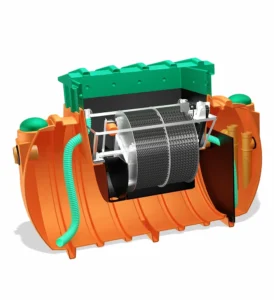 RotoClean is a biological wastewater treatment plant from Nolen that utilizes rotating biological contactor technology. It is a solution designed for treating domestic wastewater in locations without access to a sanitary sewer system.
The design of the treatment plant comprises a reinforced horizontal tank divided into several zones. Inside, it contains:
- primary settling tank,
- rotating biological contactor,
- secondary clarifier,
- geared motor,
- drive belt,
- partition,
- inspection covers.
A low-speed geared motor drives the rotation of the biological bed. Thanks to the technology employed, the microorganisms developing on the bed participate in the biological treatment of wastewater.
RotoClean wastewater treatment plant specifications
According to the information on the manufacturer’s website, the RotoClean model has the following dimensions:
- Height: 190 cm,
- width: 145 cm,
- length: 280 cm,
- inlet: 100 cm from the bottom,
- drain: 87 cm from the bottom,
- standard superstructure: 25 cm.
The RotoClean residential biological wastewater treatment plant may be an attractive solution for investors seeking a system based on a rotating biological contactor. Before purchasing, it is advisable to check the current technical specifications and installation requirements.
2. Residential SBR biological wastewater treatment plant
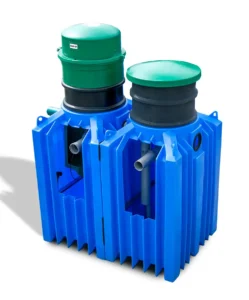
An SBR biological wastewater treatment plant is a model that utilizes batch wastewater treatment technology. The acronym SBR stands for “Sequencing Batch Reactor.”
In this type of treatment plant, the purification process takes place in specific phases. Wastewater flows into the system and then undergoes successive stages of biological treatment and clarification.
The SBR model offered by Nolen is equipped with, among others:
- primary settling tank,
- the biological reactor chamber,
- moduł sterujący,
- control module,
- secondary sludge pump,
- treated wastewater pump,
- aeration diffusers,
- the settling tank cover.
The SBR treatment plant is designed for the treatment of domestic wastewater. The manufacturer indicates that this solution is suitable for use under various soil and groundwater conditions, provided it is installed correctly and operated in accordance with the manufacturer’s requirements.
How does an SBR biological wastewater treatment plant work?
The operation of an SBR treatment plant is cyclical. In simplified terms, the process may include:
- Wastewater inflow – domestic wastewater enters the system.
- Aeration – oxygen supplied by diffusers supports the activity of microorganisms.
- Biological treatment – bacteria break down some of the organic pollutants.
- Sedimentation – the sediment is separated from the liquid being purified.
- Discharge of treated wastewater – upon completion of the appropriate phase, the water may be directed to the designated receiving point.
The exact course of the cycle depends on the device configuration and controller settings.
3. BDH biological home wastewater treatment plant
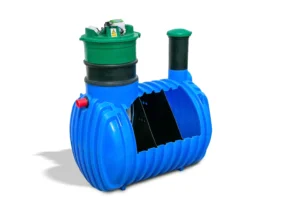 BDH is a hybrid domestic wastewater treatment plant manufactured by Nolen. It combines two biological treatment mechanisms: low-load activated sludge and a fluidized biological bed.
Hybrid technology enables the utilization of both microorganisms present in suspension and those growing on special biological carriers.
Construction of the BDH wastewater treatment plant
According to the manufacturer’s description, the BDH model consists of four main compartments:
- Chamber No. 1 – primary settling tank.
- Chamber No. 2 – first biological reactor.
- Chamber No. 3 – second biological reactor.
- Chamber No. 4 – secondary settler, or clarification chamber.
The equipment also includes aeration diffusers, a fluidized biological bed, and a treatment plant controller with an operation monitoring system. A sludge recirculation system featuring an airlift pump enables the transfer of sludge from the secondary clarifier to the primary clarifier.
Why is it worth considering the BDH model?
The BDH hybrid biological wastewater treatment plant may be a suitable solution for those seeking an advanced system for treating domestic wastewater. Combining activated sludge with a fluidized biological bed allows for the use of various treatment mechanisms within a single unit.
This model is particularly worth considering when planning an installation for a single-family home or another facility lacking access to a centralized sewer system. The final selection should take into account the system design, projected wastewater inflow, and requirements regarding the receiving body for the treated effluent.
4. Soft SBR residential biological wastewater treatment plant
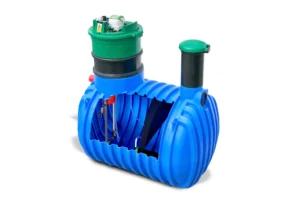 Soft SBR is a biological wastewater treatment plant from Nolen that operates using sequencing batch reactor technology. The system utilizes activated sludge, which is responsible for the biological degradation of pollutants.
Unlike solutions utilizing rotating biological contactors, Soft SBR bases the treatment process on the operation of an aerated biological reactor.
Soft SBR wastewater treatment plant components
The system includes, among other things:
- wastewater treatment plant tank serving as a biological reactor,
- aeration diffuser,
- wastewater treatment plant controller,
- aeration blower,
- mammoth pump,
- clarification chamber, i.e., secondary clarifier,
- partition,
- wastewater inflow,
- discharge of treated wastewater.
Aeration provides the conditions necessary for the growth of aerobic microorganisms. An airlift pump facilitates the transport of liquid and sludge within the technological process.
Who is the Soft SBR wastewater treatment plant designed for?
The Soft SBR model may be considered by owners of single-family homes and other facilities where biological treatment of domestic wastewater is necessary.
When choosing this model, it is worth analyzing:
- number of people using the installation,
- expected amount of sewage,
- method of discharging purified water,
- availability of electricity,
- assembly conditions,
- device servicing requirements.
5. PureFlow home biological treatment plant
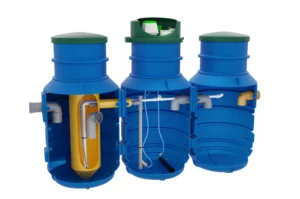 PureFlow is another biological wastewater treatment plant model from Nolen. The device’s design includes several zones responsible for subsequent stages of wastewater treatment.
The PureFlow model features, among others:
- primary settling tank,
- biological reactor,
- Imhoff’s funnel,
- secondary settling tank,
- control module,
- mammoth pump,
- mammoth recirculation pump,
- aeration diffuser,
- settler covers.
The manufacturer also offers a variant with a built-in pumping station for treated sewage. Depending on the configuration, drainage can be achieved through a standard pipe or a pumping station solution.
Application of the PureFlow model
The PureFlow domestic biological treatment plant can be used in households, residential buildings and other facilities where domestic and industrial wastewater must be treated before further disposal.
When choosing the appropriate variant, pay attention to:
- type of receiver of treated sewage,
- the difference in height between the outflow from the treatment plant and the water discharge point,
- the need to use a pumping station,
- available space for installation,
- soil and water conditions.
Biological or ecological sewage treatment plant – which one to choose?
Nolen’s offering includes both biological domestic wastewater treatment plants and ecological treatment plants with infiltration drainage. Although all are designed to treat domestic wastewater, their design and operation differ.
Home biological treatment plant
A biological wastewater treatment plant uses microorganisms to break down pollutants. Depending on the model, the process may involve activated sludge, biological filters, or a hybrid technology.
The most important features of such solutions include:
- biological wastewater treatment,
- possibility of use in households,
- use of advanced technological processes,
- use of controllers, blowers or pumps in selected models,
- the ability to adapt the solution to the conditions of a specific plot.
Home ecological sewage treatment plant with infiltration drainage
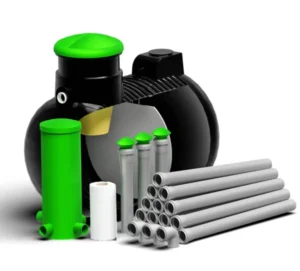 Ecological sewage treatment plants with infiltration drainage are solutions in which, after preliminary treatment, the sewage is directed to the infiltration system.
Nolen offers models such as:
- B.1,
- B.1.5,
- B.2,
- B.3,
- B.4,
- P.3,
- P.4,
- P.5,
- P.6.
For models B.1–B.4, the manufacturer recommends the use of septic tanks and percolation drainage. Available variants differ in tank capacity and design, among other things.
Important: Biological treatment plants and drainage treatment plants are not identical solutions. Before purchasing, check the technology used for a specific model and whether it is suitable for the conditions on your property.
How to choose the right model of home biological treatment plant?
The purchase of a biological wastewater treatment plant should be preceded by an analysis of the technical and operational requirements. Tank capacity alone is not sufficient to properly configure the installation.
1. Number of users
One of the most important parameters is the number of people using the treatment plant. Both permanent residents and any seasonal users should be taken into account.
A treatment plant that is too small may not provide the proper conditions for the treatment process to proceed properly. Oversizing the system, on the other hand, can increase purchase and installation costs.
2. The amount of domestic sewage
Before selecting a model, you should determine your projected daily wastewater inflow. It’s worth considering:
- number of inhabitants,
- water consumption,
- frequency of use of sanitary facilities,
- seasonality of building use,
- possible additional sources of sewage.
The selection of bandwidth should be consistent with the technical documentation of the selected device.
3. Soil and water conditions
Ground and water conditions are crucial for the installation of a domestic sewage treatment plant. Before commencing the project, it is important to check:
- type of soil,
- groundwater level,
- subsoil permeability,
- terrain,
- possibility of making a drain,
- availability of space for installation.
In the case of treatment plants with infiltration drainage, it is particularly important to check whether the ground allows for proper infiltration of sewage.
4. Method of discharging treated sewage
The purified water can be directed to an appropriate receiver, the choice of which depends on the plot conditions and applicable regulations.
In the documentation for the BDH model, the manufacturer lists, among others:
- drainage or seepage tunnels,
- a drainage well,
- tight, drainless tank,
- pond,
- watercourse.
The possibility of using a specific method of sewage disposal must be confirmed each time for a given installation and local formal and technical conditions.
5. Electric power supply
Some biological wastewater treatment plants require power for aeration devices, pumps, or controllers. This includes models equipped with blowers and automatic control systems.
Before purchasing, please check:
- power requirements,
- electricity consumption,
- method of securing the installation,
- service availability,
- maintenance requirements.
6. Compliance with documentation and technical requirements
Nolen’s product pages indicate the compliance of the presented models with the PN-EN 12566-3+A2:2013-10 standard. However, before purchasing, please check the current technical documentation for a specific model, the scope of declared compliance, and the requirements for its installation and use.
Advantages of a home biological treatment plant
Biological sewage treatment plants are increasingly being chosen by owners of single-family homes and properties located beyond the reach of the collective sewer system.
The most important benefits include:
Ecological wastewater treatment
Biological processes reduce the amount of pollutants contained in wastewater. Depending on the technology and operating conditions, a treatment plant can effectively treat domestic wastewater.
An alternative to a traditional septic tank
A domestic sewage treatment plant can be an alternative to a septic tank. A properly selected and operated system can reduce the frequency of sewage disposal, which can translate into lower operating costs.
Can be used in areas without sewage systems
Biological sewage treatment plants are intended, among others, for buildings located in places without access to sanitary sewers.
Modern purification technologies
The models offered by Nolen use various technologies, such as:
- biological rotating beds,
- activated sludge,
- SBR technology,
- fluidized biological beds,
- hybrid solutions.
This makes it possible to tailor the type of treatment plant to the individual needs of the investor.
Installation and operation of a biological sewage treatment plant
Correct installation of a home biological treatment plant has a direct impact on its operation, durability and safety of use.
Before starting work, it is necessary to prepare appropriate documentation and analyze ground and water conditions. Depending on the model, it may be necessary to excavate, prepare the subgrade, connect sewer lines, electrical systems, and drain treated sewage.
The most important operating principles
For a biological sewage treatment plant to function properly, it is necessary to:
- follow the manufacturer’s instructions,
- perform periodic inspections,
- control the operation of the controller and aeration devices,
- remove sediment as recommended,
- do not discharge substances harmful to microorganisms into the sewage system,
- keep the pipes clear,
- check the technical condition of pumps and blowers, if present in a given model.
Improper operation may lead to deterioration of the quality of wastewater treatment, equipment failure or the need for additional service work.
Nolen home biological treatment plants – summary of available models
Nolen offers several models of biological wastewater treatment plants that utilize different treatment technologies. Choosing the right solution should depend on the site’s conditions, population, wastewater volume, and the project’s technical capabilities.
| Model | Technology | Key features |
|---|---|---|
| RotoClean | Rotating biological bed | Tank with primary settling tank, rotating bed and secondary settling tank |
| SBR | Sequential Batch Reactor | Primary settling tank, biological reactor, aeration and control |
| BDH | Hybrid technology | Activated sludge, fluidized bed, two biological reactors and sludge recirculation |
| Soft SBR | Activated sludge, SBR technology | Biological reactor, blower, diffusers, airlift pump and clarification chamber |
| PureFlow | Biological wastewater treatment | Primary settling tank, biological reactor, Imhoff funnel, secondary settling tank and recirculation system |
The models described are presented in Nolen’s offer as solutions for biological treatment of domestic wastewater. Before making a decision, it is advisable to review the full technical documentation, current equipment options, and installation instructions.
Why choose the Nolen sewage treatment plant?
Nolen specializes in plastics processing and the production of rotationally molded products. One of the company’s areas of activity is the production of domestic sewage treatment plants, tanks, and other solutions for commercial and industrial applications.
The range includes biological and ecological wastewater treatment plants, septic tanks, and treatment system accessories. Thanks to the variety of available solutions, investors can compare different technologies and select the right product for their planned investment.
Are you looking for a suitable home biological treatment plant? Explore Nolen’s offerings and check out the available models: RotoClean, SBR, BDH, Soft SBR, and PureFlow. Before purchasing, consult with the manufacturer or a specialist to ensure the treatment plant meets the technical requirements and needs of your property.
SZUKAJ
Categories
Recent Posts
- Biological home wastewater treatment systems – available models. How to choose the best wastewater treatment system?
- Nolen Diesel Fuel Tanks in Crisis Management – Safety and Energy Independence
- Ecological sewage treatment plant – what is it, how does it work and why is it worth having?
- How to Choose a Rainwater Tank?
TAGI
BDH
BDH biological wastewater treatment plant
biological wastewater treatment plant
cesspool
domestic wastewater treatment plant
eco-friendly septic tank
eco-friendly wastewater treatment plant
home biological wastewater treatment plant
home sewage treatment plant with activated sludge
home wastewater treatment plant
household wastewater treatment plant
installation of a residential biological wastewater treatment system
manufacturer of home wastewater treatment systems
models of home wastewater treatment plants
Nolen home wastewater treatment plants
PureFlow biological wastewater treatment plant
Roto-Clean
RotoClean biological wastewater treatment plant
sewage treatment plant for a single-family home
sewage treatment plant without a sewer connection
Soft SBR wastewater treatment plant
wastewater treatment plant
wastewater treatment plant with a soil absorption system
Close


// ŚLEDŹ NAS
Cart (0 items)