



Rainwater tanks EKO OG 2.0, 3.0, 4.0
Rainwater harvesting systems enable its storage and subsequent use for domestic and commercial purposes. Nolen Sp. z o.o., meeting customer expectations, has developed and introduced a wide range of solutions – from simple systems to advanced, comprehensive installations. A properly selected and designed system can significantly reduce the consumption of expensive tap water, contributing to savings and sustainable resource management.
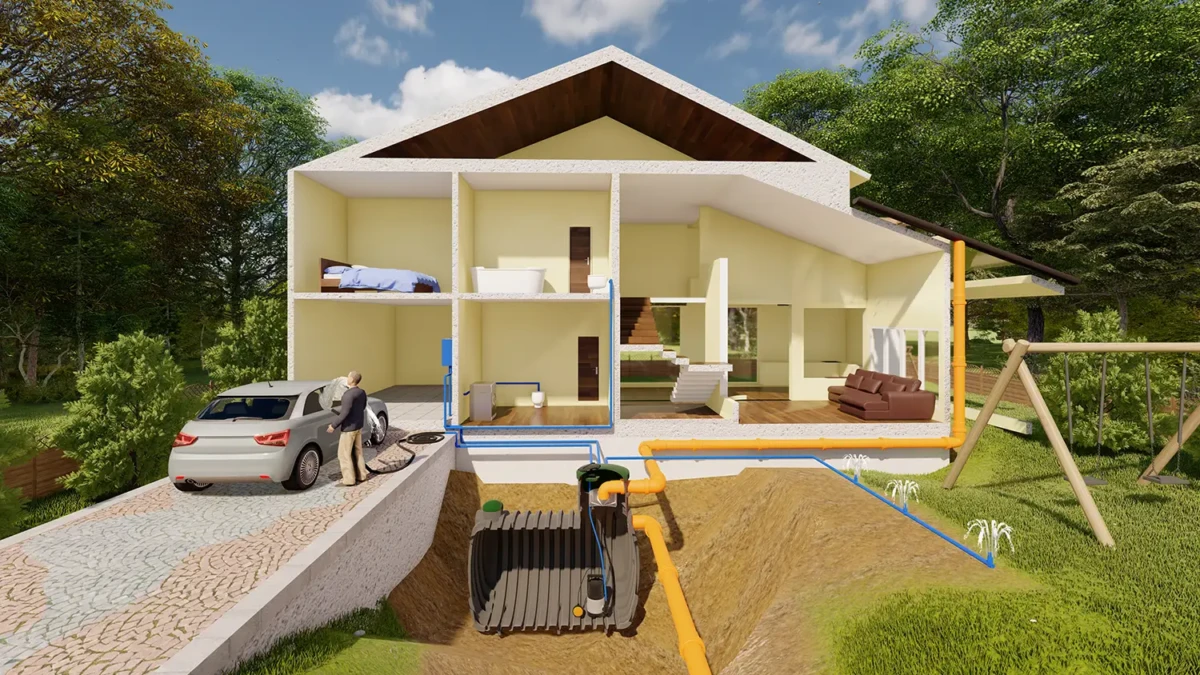
A basic rainwater collection and storage system consists of an underground tank into which rainwater flows. It then undergoes a filtration process, the degree of sophistication of which depends on the solutions used and the planned water use. Standard equipment includes a filter located inside the tank, which traps solid contaminants such as leaves, small twigs, and other debris.
RAINWATER TANK DIAGRAM – EKO OG 2.0, EKO OG 3.0, EKO OG 4.0
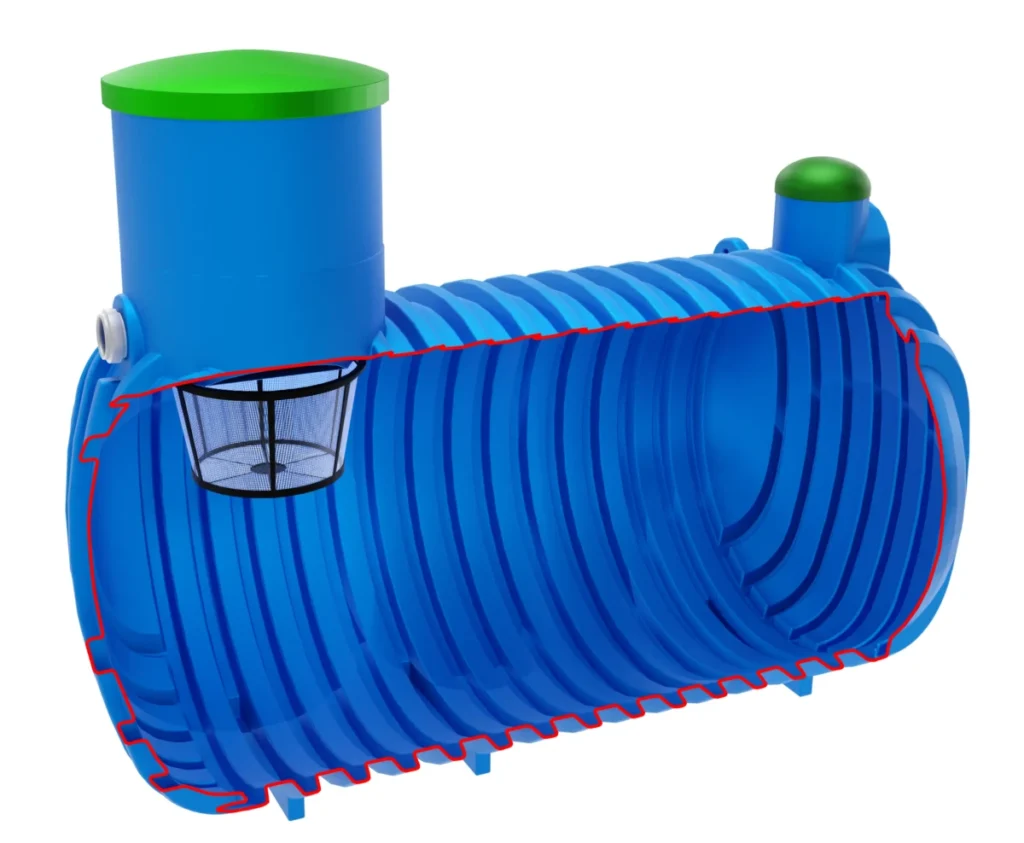

BASIC EQUIPMENT
- tanks with a capacity of 2000L, 3000L, 4000L
- mesh filter basket
- tank cover.
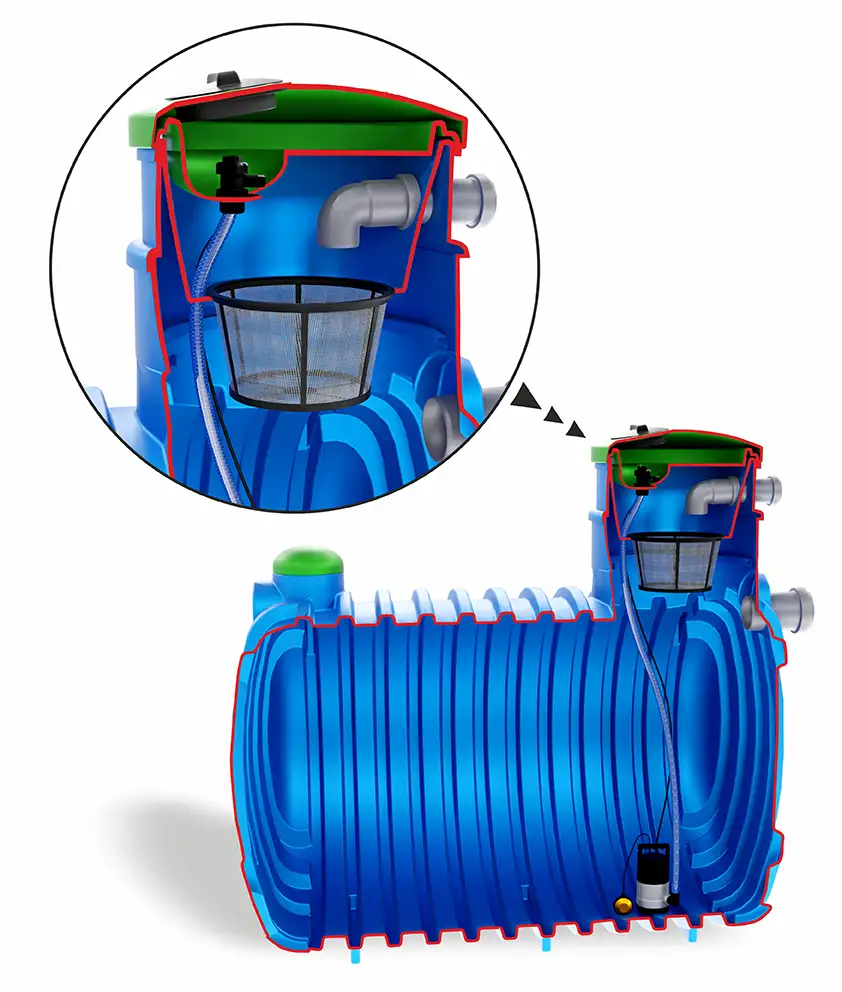
ADDITIONAL EQUIPMENT
- tank extensions with a height of 50 or 100 cm
- connecting cables made of PVC pipes
- float water pump
- automatic water pump
- rain central
RAINWATER KIT
Tanks should be transported in a horizontal position (inspection shafts vertical) and properly secured with lashing straps. The customer/buyer should be present during unloading – the unit should be inspected. Care should be taken when moving the tank. The tank should be lifted using a rope or sling through the handle attached to the tank, or from underneath using a forklift. Carefully lift the tank from the delivery vehicle and place it on a level surface. Do not roll the tank off the delivery vehicle; tanks should not be thrown or dragged along the ground.
There is a handle at the top to which safety belts can be attached.
General rules
- To maintain the good condition and operation of the device, please follow this instruction manual and its attachments.
- Any defects noticed should be reported to the manufacturer/seller.
- Improper installation may result in incorrect operation of the treatment plant.
- The excavation and installation of the treatment plant should be carried out by a specialized contractor.
- Never enter an unventilated tank – LIFE HAZARD!
- Make sure that the ground around the treatment plant does not contain any factors that may have a negative impact during and after installation (ensure a stable position, maintain a safe distance from buildings).
- Work should not be carried out during heavy rainfall (risk of excavation collapse).
- Ground settlement must be taken into account during all installation work.
Before starting installation, check whether the tank has not been damaged during transport.
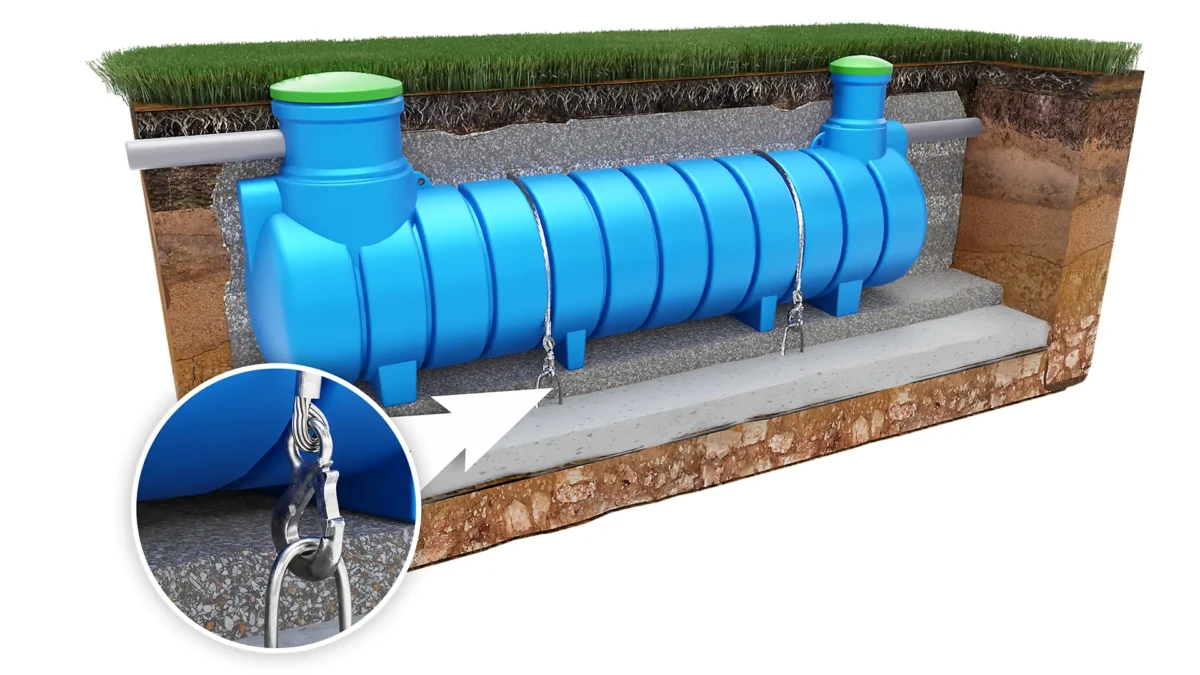
We dig a trench for the tank with dimensions 0.5–1.0 m larger than the tank’s dimensions. The minimum backfill width is 50 cm on each side of the tank.
We make a bedding layer at least 30 cm thick with a mixture of cement and sand in a 1:3 ratio and compact it to at least 85% (according to the Proctor scale).
We lower the tank into the excavation, level it and make the first 30 cm layer of cement and sand backfill to stabilize it (in a 1:3 ratio and compact it to at least 85% according to the Proctor scale).
After leveling and stabilizing the tank, we apply backfill in layers every 30 cm, simultaneously compacting it to the level of the discharge nozzle according to the proportion and degree of compaction as above (in a 1:3 ratio and compacted to at least 85% according to the Proctor scale). During backfilling, the settling tank should be filled with water so that the water level is always slightly higher than the backfill level.
After completing the backfill and compacting it, we connect the inlet and outlet pipes, simultaneously connecting them to the distribution pit.
Install the DN 650 extension, adjusting its height to the expected ground level (terrain), and complete the backfilling and compaction. When installing the extension, it is essential to seal the connection point to the tank with a special adhesive (e.g., Wurth adhesive + sealant) or other suitable sealant, and then secure it with screws (e.g., Farmer screws). The tank should not be covered by more than 120 cm.
After completing the installation of the settling tank, a leak test should be performed.
After completing the above-mentioned works, we begin installing the drainage.
ter excavating, depending on the type of soil, we create a protective layer while installing drainage pipes and, if necessary, a supporting layer and covering it with geotextile.
Minor tank deformations are due to the properties of the material used and do not affect the proper operation of the treatment plant. Tank deformation of no more than 5% is permissible.
HDPE TANK INSTALLATION

My Water
The Polish Institute of Meteorology and Water Management (PIMWM) consistently emphasizes that we are experiencing a hydrological drought in our region. Poland has been experiencing regular droughts for many years, and the situation is unlikely to improve. The water situation in our country is poor and getting worse. The “Moja Woda” (My Water) program has been launched with a budget of PLN 130 million, which could bring numerous benefits. The program aims to protect water resources by increasing retention on single-family homes and utilizing collected rainwater and meltwater, including through the development of green and blue infrastructure. We offer high-quality reservoirs that meet all the standards and certifications of the “Moja Woda” program, making our reservoirs eligible for reimbursement.
When choosing a water tank, we ask ourselves many questions?
- Does a Rainwater Tank Require a Permit?
- Does a rainwater tank require notification?
- What kind of rainwater tank?
- How to Choose a Rainwater Tank?
- How to install a rainwater tank?
- What is the price of a rainwater tank?
- Na każde z tych pytań odpowiemy pod nr tel.: (+48) 664 101 600
Nolen offers rainwater collection systems that allow for the collection and use of rainwater instead of water drawn from mains water supplies or deep wells. We prioritize a personalized approach to each client: we always prepare a dedicated design and installation tailored to the user’s needs and local conditions. Our rainwater systems can be used year-round – even during persistently sub-zero temperatures in winter.
Using rainwater as part of a rainwater collection system is environmentally friendly, significantly reducing water bills. If you have a garden, a rainwater tank equipped with a pump can generate significant savings – especially during periods of drought, when plants require intensive watering and water supply disruptions can occur. However, this is not the only way to utilize rainwater.
EKO-OG product data
Rotomolding Products
- RotoClean biological home sewage treatment plant
- Domestic Biological Wastewater Treatment Plant SBR
- BDH Biological Domestic Wastewater Treatment Plant
- Biological Domestic Wastewater Treatment Plant Soft SBR
- PureFlow Biological Domestic Wastewater Treatment Plant
- EKO OG Domestic Wastewater Treatment Plant
- Domestic Wastewater Treatment Plant B.1, B.1.5
- Domestic Wastewater Treatment Plant B.2, B.3, B.4
- Domestic wastewater treatment plant P.3, P.4, P.5, P.6
- Nolen Wastewater Treatment Plant Accessories
- Septic Tanks – Plastic Cesspools
- 1000 Litre Nolen Fuel Tank
- 1500 Litre Nolen Fuel Tank
- Fuel tank 1500 B Liters Nolen
- 2500 Liter Fuel Tank Nolen
- 2500B Liters Nolen Fuel Tank
- 5000 Litre Nolen Fuel Tank
- 9000 Litre Nolen Fuel Tank
- Liquid fertilizer tanks (RSM)
- 250L fuel tank – mobile
- 460L fuel tank – mobile
- 600L fuel tank – mobile
- Accessories for diesel tanks
- Rainwater tanks EKO OG 2.0, 3.0, 4.0
- Rainwater tanks B.1, B.1.5
- Rainwater tanks B.2, B.3, B.4
- Rainwater tanks P.3, P.4, P.5, P.6